NFACC Information Update: June 2026

In this issue:
- Updates on Codes of Practice Under Revision
- NFACC Achievements Report Released
- Animal Health Canada Forum 2026 – Register Now
UPDATES ON CODES OF PRACTICE UNDER REVISION
Sheep Code Update
The sheep Code update has reached an important stage. At its fourth in-person meeting in Ottawa, the Code Committee (CC) completed its review of the draft Code and worked through a final round of refinements ahead of the Public Comment Period (PCP).
Not all questions can be resolved through committee discussion alone. During its deliberations, the CC identified one area where additional insight from those working directly with sheep would be valuable. To better understand current practices, a survey was conducted with sheep producers and veterinarians. The results provided important on-the-ground perspectives and helped inform the CC's discussions and decision-making.
Mark your calendar! Preparations are now underway for the Public Comment Period, which will begin Monday, August 10, 2026 and remain open for 60 days, closing on Friday, October 9, 2026. Feedback received during the consultation will play an important role in informing revisions to the Code before it is finalized.
Previous progress updates can be found here with more information on the sheep Code here.
Beef Cattle Code Update
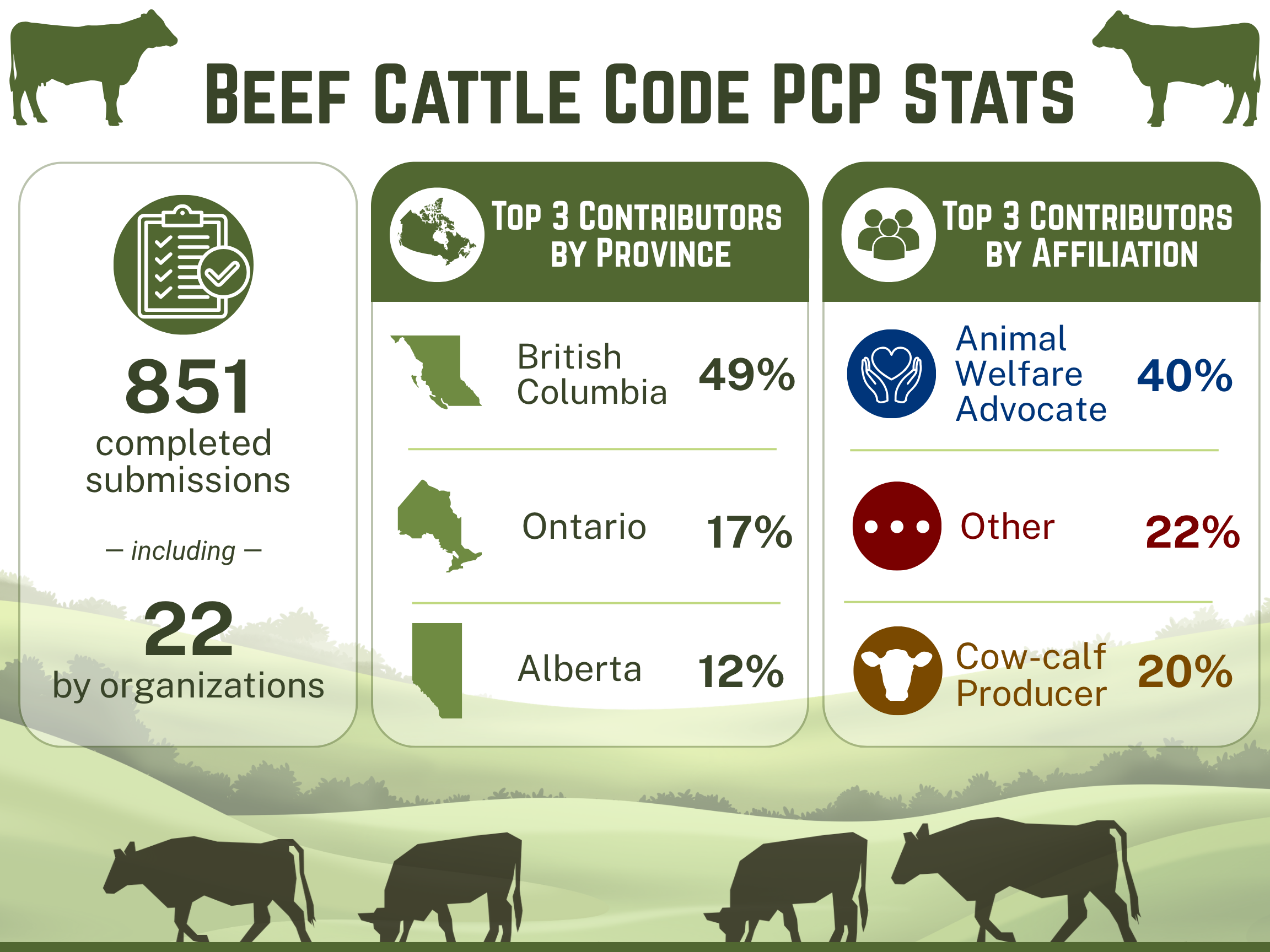
The beef cattle Code Public Comment Period (PCP) was held from April 13th - June 12th, 2026. Thank you to everyone who participated and submitted comments! The beef Code Committee (CC) is now working to collate and review all comments. The PCP submissions will be used to guide the CC in the next stage of their deliberations as they prepare for their upcoming meeting in August.
The beef cattle Scientific Committee (SC) report has successfully undergone peer review and is available here.
Previous progress updates can be found here with more information on the beef cattle Code here.
Equine Code Update
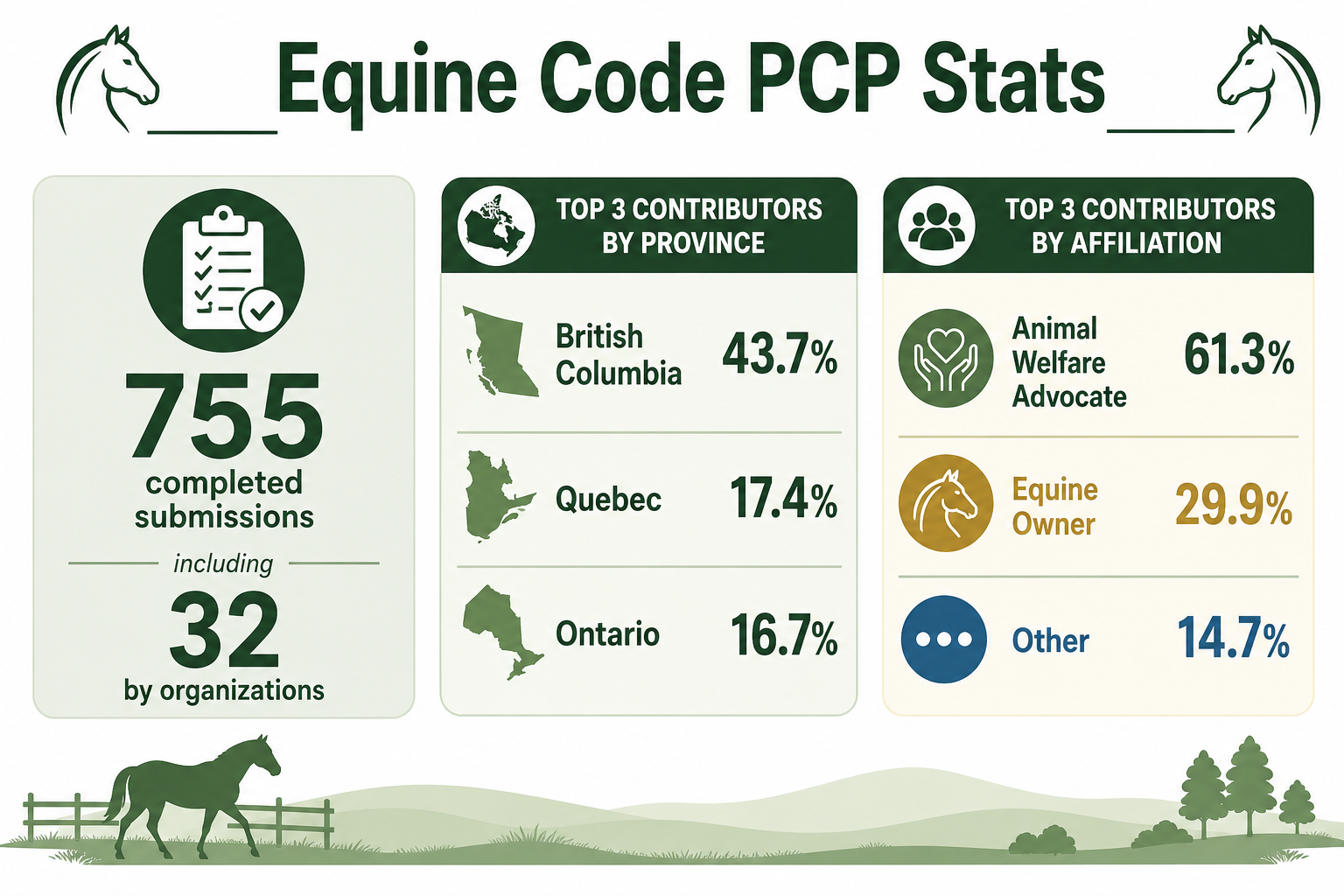
Following the close of the equine Code Public Comment Period (PCP) in March, 2026 the equine Code Committee (CC) carefully reviewed all comments received. The CC wishes to thank all PCP contributors. All materials were read with the principal intent of identifying in-scope, content-related recommendations/suggestions, comments, or questions that the CC may have failed to address or fully consider during the initial preparation of the draft Update. The CC then met in-person in April to discuss all content reviewed to consensually decide upon prospective new edits/insertions to the draft.
Moving forward, all subcommittees will continue to make prospective edits/revisions to their respective sections before presenting any/all remaining proposals to the entire CC during several online meetings over the summer. Following these virtual discussion sessions, the CC will gather for one final in-person meeting to agree upon any still outstanding edits, changes, or additions.
Previous progress updates can be found here with more information on the equine Code here.
Hatching Eggs, Breeders, Chickens, and Turkeys Code Update
The poultry Code Committee (CC) gathered in Edmonton in early April for its third in-person meeting. With a substantial amount of material slated for review, the CC faced one of its most ambitious agendas to date. Through focused discussion and deliberation, members worked through the majority of planned items and made significant progress toward preparing draft sections for the Public Comment Period (PCP).
A major project milestone was also reached, with all chapters of the Scientific Committee (SC) report now presented to the CC. Peer review is now underway. The SC's work has provided an important scientific foundation to help inform discussions and decision-making.
The CC's current focus is on advancing individual sections to PCP-ready status. While considerable progress has been made, a busy schedule of virtual meetings and document review activities remains ahead. The next in-person meeting is scheduled for August, where the CC will undertake a final review of the full draft before preparations begin for public consultation.
Previous progress updates can be found here with more information on the poultry Code here.
Pig Code Update
The pig Code Committee (CC) held its first in-person meeting in October 2025. Since then, the CC has made consistent progress as members become increasingly familiar with the NFACC Code process and with one another. After initially opting to meet only as a collective, smaller Subject Matter Expert (SME) groups have since been formed. These groups allow members with specific expertise to thoroughly review distinct Code topics and share prospective updates during collective CC meetings, where all proposed edits are discussed as a full group.
To date, most SMEs have focused on Code content tied to updates from the Scientific Committee (SC), which continues to review and present current findings on the Priority Welfare Issues (PWIs) agreed upon in 2025. Other SMEs are focused on chapter-specific content, such as Transportation. SME Leads are also assuming more direct administrative oversight of their respective groups—setting meeting times, assembling prep materials, and capturing edits for presentation to the CC.
To accommodate a more accelerated pace:
- The number of active SMEs has multiplied, with groups meeting more often.
- The CC has increased the frequency of its online meetings.
- Collective CC meetings have become lengthier, moving from two hours to three.
- Discussions across both CC and SME meetings have become notably more active and fast-paced.
- Committee meetings of one type or another are now occurring weekly, on average.
As committee members increasingly recognize and draw upon the diverse expertise within the group, the review effort continues to gain efficiency. All meetings remain collegial, educational, and highly collaborative.
Operating in parallel to the CC, the Scientific Committee has maintained a rapid pace of researching and presenting summary updates on the PWIs. These topic reviews were mutually intended to benefit the CC throughout the update process. During each update, the SC Chair provides presentations to the full CC. These updates will ultimately be compiled into a single report, peer-reviewed, and published on the NFACC website prior to the Public Comment Period (PCP). This process maximizes efficiency, ensuring the collective committee can review science-based information in a timely manner.
Over the summer, alongside planned monthly CC meetings, all SME groups will maintain a regular schedule. The full CC will next meet for an extended, two-day virtual session in early October. The committee expects to maintain this steady pace until the 60-day Public Comment Period begins in early 2027.
Previous progress updates can be found here with more information on the pig Code here.
NFACC ACHIEVEMENTS REPORT RELEASED
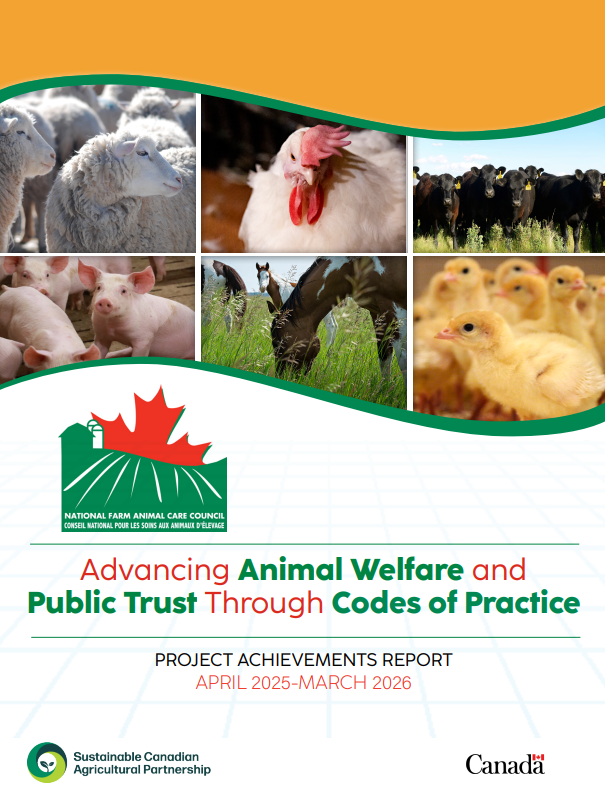
NFACC is pleased to announce the release of its latest Project Achievements Report: Advancing Animal Welfare and Public Trust Through Codes of Practice report, which highlights key NFACC updates and Codes of Practice progress from April 2025 to March 2026. Among the year's key milestones:
- The draft Equine Code of Practice completed its public comment period, accompanied by the publication of a peer-reviewed scientific report.
- The draft Beef Cattle Code of Practice entered public comment, accompanied by the publication of a peer-reviewed scientific report.
- Progress was achieved on the sheep, poultry, and pig Code updates through extensive committee deliberations and scientific review.
- NFACC released new episodes of its NFACC Conversations podcast, helping stakeholders and the public better understand the value of Codes of Practice and the collaborative process behind their development.
The report also highlights the importance of public participation. Through NFACC’s public comment periods, everyone can review draft Codes and provide feedback that helps shape the final standards. Submissions are carefully reviewed and considered by Code Committees as part of NFACC’s consensus-based process.
The report is available here in both English and French alongside past Achievement Reports. We would like to thank everyone for all of the hard work that went into the achievements and progress outlined within!
ANIMAL HEALTH CANADA FORUM 2026 – REGISTER NOW
Forum 2026 theme: Turning insight into action for Canada’s animal health and welfare system
Registration is now open! Register before August 4th to take advantage of Early Bird pricing.
This year’s forum will focus on:
- Rising animal welfare expectations
- Evolving biosecurity risks
- The growing impact of misinformation and disinformation
Animal welfare session speakers include:
Dr. Nina von Keyserlingk, Professor NSERC Industrial Research Chair in Dairy Cattle Welfare and Officer of the Order of Canada
Managing Change in Animal Welfare: Trade-offs, Timelines and Courage
Mr. Robert Hoste, senior pig production economist at Wageningen Economic Research, chairman of InterPIG, and member of Dutch Council of Experts for sustainable husbandry systems.
From Policy to Practice: Global Strategies for Improving Farm Animal Welfare
Dr. Claire Windeyer, ACER Consulting
Influencing On-Farm Change
Visit AHC Forum for a full list of speakers. There are also other great ways to get involved:
- Become a sponsor and showcase your organization's commitment to our sector while connecting with a diverse audience of industry leaders and professionals.
- Nominate a colleague for an AHC Award and help recognize the outstanding individuals making a difference in our communities and industry.
Financial support was provided by Agriculture and Agri-Food Canada through the AgriAssurance Program under the Sustainable Canadian Agricultural Partnership.
Questions or comments? Contact us at info@nfacc.ca.
NFACC is a division of Animal Health Canada
